1. What is cement bulker trailer?
2. What is the use of cement bulker?
3. What is the capacity of cement bulker trailer?
4. How much does a CIMC cement bulker price?
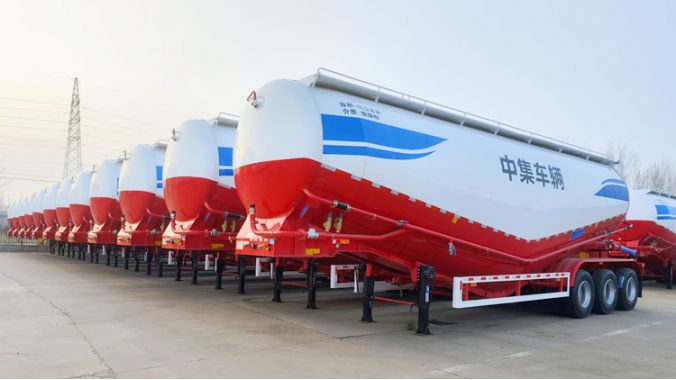
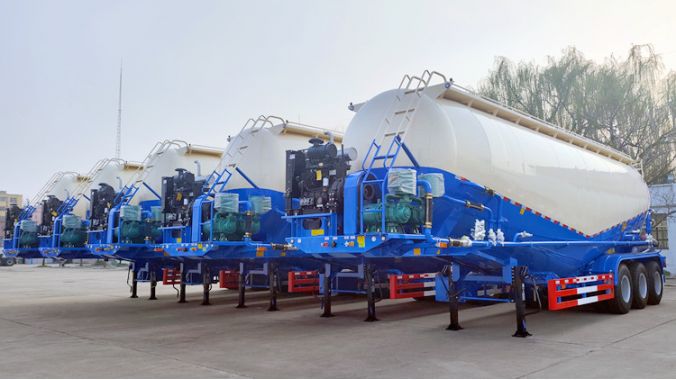
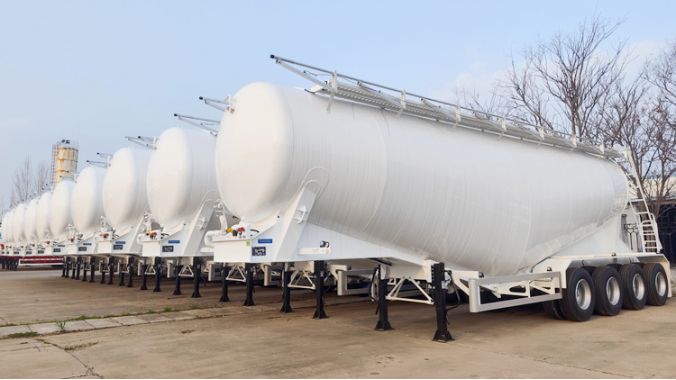
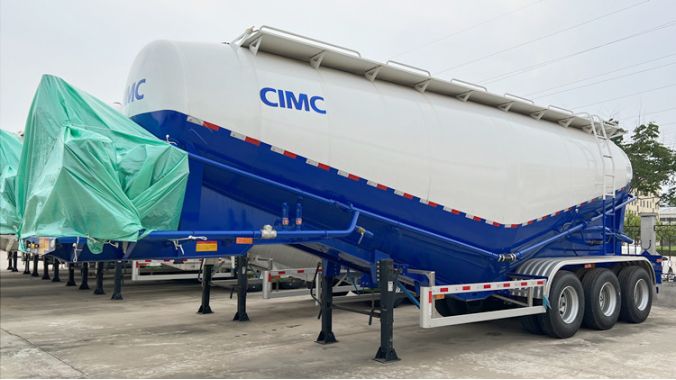
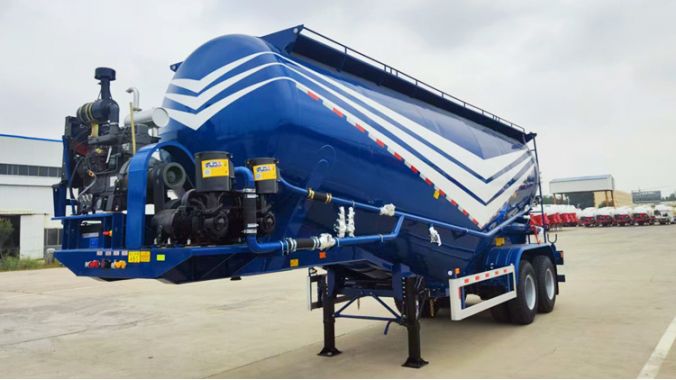
The CIMC cement bulker trailer is a specialized semi-trailer transport device manufactured by specialized factories under CIMC Vehicles Co., Ltd., such as CIMC Tonghua and CIMC Lingyu. Its core purpose is to transport bulk cement, fly ash, mineral powder, and other dry granular materials. Essentially, CIMC cement bulker trailer is a giant pressure vessel mounted on wheels, possessing extremely high sealing and pressure resistance. Its basic working principle is to use an onboard air compressor or an external air source to inject compressed air into the tank, fluidizing the cement and other powdery materials inside, and then, like a liquid, blowing them under high pressure through pipelines to cement storage towers or silos tens of meters high. This design completely avoids the packaging, loading, unloading, and unpacking processes required for traditional bagged cement transportation, making it a typical example of a modern, efficient, and bulk logistics system.
As a leading global logistics equipment manufacturer, CIMC cement bulker trailer enjoys a high reputation in the industry, one of its biggest advantages being the craftsmanship and quality assurance derived from a major manufacturer. CIMC typically uses specialized tooling and fully automated shielded welding machines in tank manufacturing to ensure that every weld is strong and reliable, possessing excellent airtightness and pressure resistance, capable of withstanding internal air pressures exceeding 0.2 MPa during unloading without leakage.
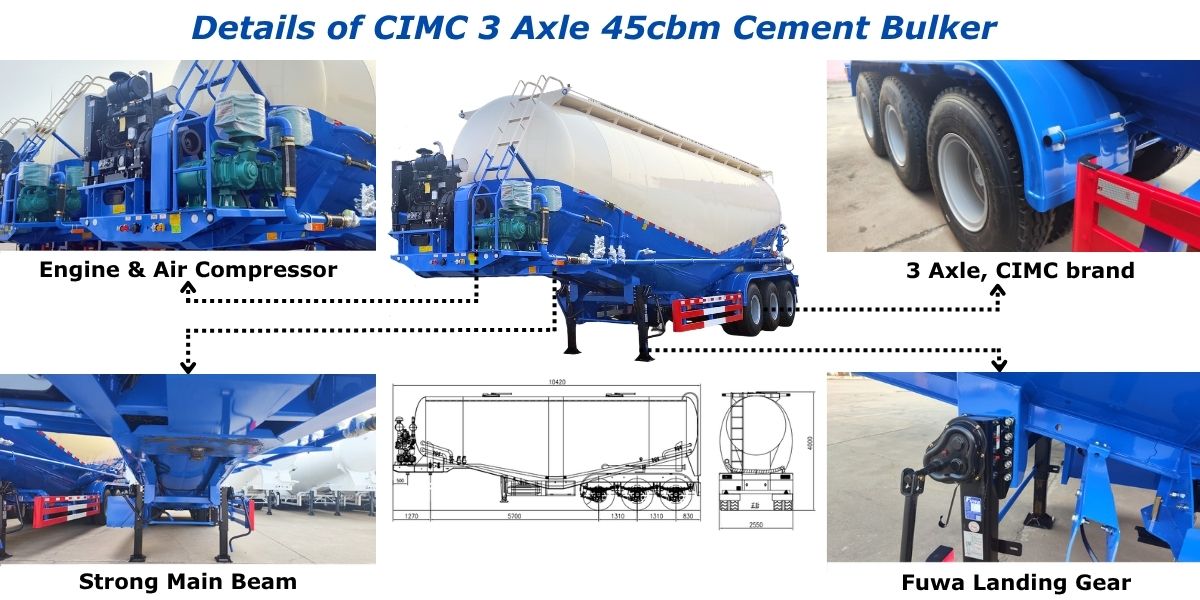
Meanwhile, the main frame beams of CIMC cement bulker trailer are made of high-strength steel such as Q345B, and have undergone specialized finite element analysis optimization specifically for the high center of gravity and large lateral tilting moments of tanks transporting powdery materials, ensuring the structural strength and driving stability of the entire vehicle. Key safety and running gear components, such as axles, braking systems, outriggers, and towing pins, are often standard or optional products from internationally renowned brands such as BPW, JOST, and WABCO, resulting in a high level of reliability, braking safety, and long-term durability under heavy loads.
In terms of specific structure and operational convenience, CIMC cement bulker trailer is also very well-designed. Their tanks are typically equipped with fluidized beds or air ducts to ensure thorough unloading with a very low residue rate, generally controlled below 0.3%, reducing material waste. The top of the tank has a manhole cover and multiple loading ports, facilitating gravity loading from cement plants and routine maintenance and cleaning. The unloading pipe interfaces at the rear or side of the CIMC cement bulker trailer are designed to allow for quick connection of hoses for unloading operations.
For users, the cost effectiveness of using CIMC cement bulker trailer is significant: it greatly reduces the consumption of cement packaging bags and labor costs for loading and unloading, achieving fully enclosed transportation from the production plant to the mixing plant, avoiding dust pollution and reducing losses during transportation. Therefore, from large concrete mixing plants and precast component factories to infrastructure construction sites such as roads and bridges, CIMC cement bulker trailer is a core force in bulk material transportation fleets. Their comprehensive advantages of high efficiency, environmental friendliness, and economy are particularly important in the context of modern logistics with increasingly stringent requirements for efficiency and cost control.
CIMC cement bulker trailer officially known as CIMC powder and granular material transport vehicles, are heavy-duty specialized transport equipment designed for transporting dry, bulk powdery or granular materials. Their core purpose is to transport various powdery and granular media from production sites to usage sites in an efficient, safe, and environmentally friendly manner, making them an indispensable link in modern industrial logistics systems.
In the building materials and infrastructure sectors, CIMC cement bulker trailer play a crucial role. They are the primary vehicle type for transporting bulk building materials such as cement, fly ash, lime powder, and expanding agents. Unlike traditional bagged transport, using powder tanker trucks to directly transport bulk cement and fly ash not only saves significant costs on packaging materials and unpacking labor but also significantly improves the efficiency of supplying materials to concrete mixing plants or construction sites. Their sealed tank structure effectively prevents materials from becoming damp and clumping or being damaged by dust during transport, ensuring the quality of building materials and the cleanliness of the construction site environment.
In terms of food and agricultural product safety, CIMC cement bulker trailer with their professional design and manufacturing standards, have opened up high-end application scenarios. CIMC Vehicles Group, leveraging its leading tank manufacturing technology, has specifically developed powder tank trucks suitable for food-grade transportation. CIMC cement bulker trailer is widely used to transport bulk food raw materials such as flour, starch, and sugar. Their tanks are made of food-grade ultra-high-strength stainless steel, fully complying with food safety regulations and effectively eliminating the risk of heavy metal migration and material contamination. By transporting ingredients such as flour directly from processing plants to food production workshops through bulk transport, the possibility of food contamination during distribution is significantly reduced, and downstream enterprises achieve automated and pipeline based receiving and feeding.
In the chemical and industrial raw material sector, CIMC cement bulker trailer also demonstrate strong applicability and professionalism. Addressing the needs of the chemical industry, CIMC has launched tank trucks made of aluminum alloy or carbon steel, specifically designed for transporting chemical raw materials and powders such as polyethylene, polypropylene, PTA, carbon black, and aluminum powder. Particularly noteworthy is CIMC's launch of lift-type powder tank semi-trailers for high-end chemical materials such as PTA. This type of CIMC cement bulker trailer utilizes a hydraulic lifting device to assist unloading, completely transforming the previous reliance on manual handling and dismantling of bagged materials. This not only avoids secondary pollution during transport but also significantly reduces worker workload and environmental problems caused by packaging bag waste, truly achieving clean and efficient bulk logistics.
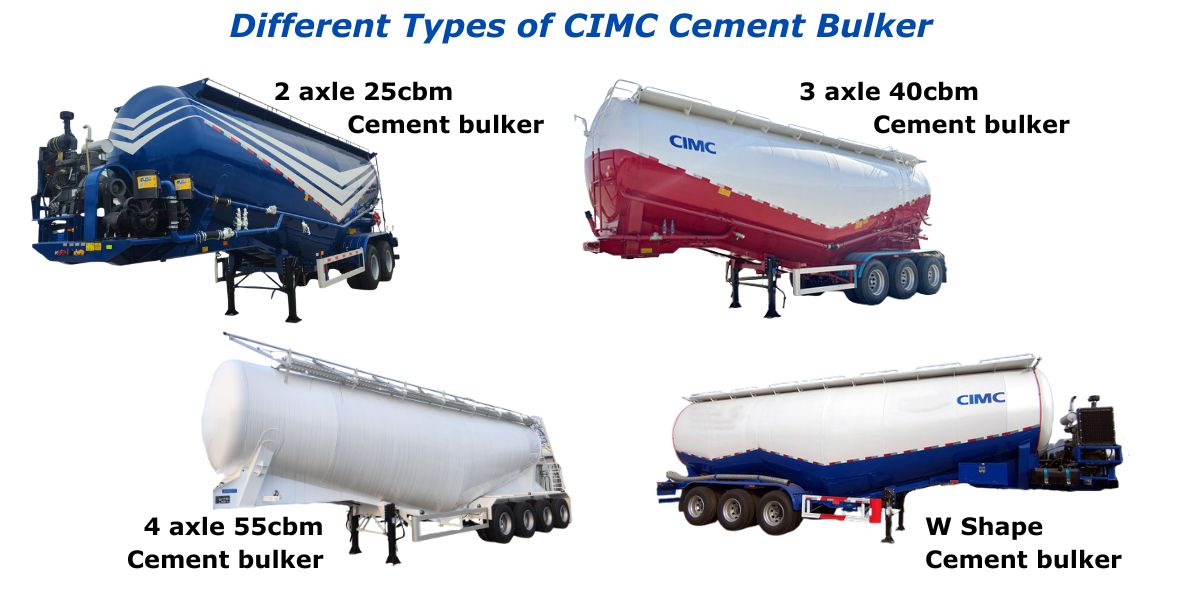
Furthermore, CIMC continuously optimizes the core performance of its cement bulker trailer through ongoing technological innovation. For example, its patented elongated oval tank cross-section design and internal fluidization device increase the effective volume by approximately 15% compared to traditional circular tanks, while reducing the residual ash rate after unloading by approximately 22%. This means a larger loading capacity per trip and less material remaining in the tank, directly reducing transportation costs and material losses for customers. Simultaneously, its products are designed with a strong emphasis on vehicle center of gravity control and lightweight construction. For instance, the V-shaped tank design used in carbon steel cement bulker trailer effectively lowers the overall center of gravity, improving stability and safety during high-speed driving or cornering.
The capacity of a CIMC cement bulker trailer is not fixed but designed based on the type of material being transported, the transport distance, road regulations, and the actual needs of the customer. Generally, the common CIMC cement bulker trailer volumes on the market range from 20 cubic meters to 80 cubic meters, with the most common sizes being 35 cubic meters, 40 cubic meters, 45 cubic meters, 50 cubic meters, and 60 cubic meters.
For companies transporting bulk powdery materials such as cement, fly ash, mineral powder, and lime powder, different capacity CIMC cement bulker trailer can meet different working conditions and transport scenarios. For example, in short distance transport around cities, many customers prefer 35-45 cubic meter CIMC cement bulker trailer because this type of vehicle balances load capacity and road maneuverability. For long distance transport or large scale engineering projects, large capacity CIMC cement bulker trailer of 50 cubic meters or more are more popular, effectively increasing the amount transported per trip and reducing transportation costs.
The actual loading capacity of a CIMC cement bulker trailer is not only related to the tank volume but also closely related to the density of the transported material. For example, the density of ordinary bulk cement is typically around 1.2 tons per cubic meter. Therefore, a 40cbm cement bulker trailer can theoretically transport about 48 tons of cement. However, in actual loading, the weight and axle load limits imposed by road regulations in different countries must be considered. When transporting lighter materials such as fly ash and mineral powder, the tonnage loaded by a CIMC cement bulker trailer of the same volume will be reduced. Therefore, many customers, when purchasing CIMC cement bulker trailer, do not simply pursue a larger volume, but rather comprehensively consider volume, load capacity, operational efficiency, and local transportation policies to choose the most suitable model.
Currently, CIMC cement bulker trailer on the market are mainly divided into two structures: V type and W type. V type cement bulker trailer typically have a smaller volume, mostly used for transportation needs between 30-50 cubic meters. They have a simple structure, are lightweight, and have a fast unloading speed, making them very suitable for the cement transportation industry. W type large capacity CIMC cement bulker trailer, on the other hand, can reach 60 cubic meters or even over 80 cubic meters. They increase loading space through optimized tank structure while ensuring vehicle stability. The large capacity CIMC cement bulker trailer is becoming increasingly popular in markets such as Africa, the Middle East, Southeast Asia, and South America. This is because many countries have long transportation distances, and large capacity vehicles can significantly reduce fuel and labor costs, thereby increasing transportation revenue.
The selection of CIMC cement bulker trailer capacity is a highly customized technical decision that directly relates to transportation efficiency, compliance, and operational economics. Users typically choose the most suitable and effective volume vehicle based on the specific characteristics of the materials they are transporting.
The CIMC cement bulker price is not a fixed figure, but is determined by a combination of factors, including vehicle configuration, tank volume, steel material, axle brand, market transportation demand, and the regulations of the exporting country. Different customers have different usage environments and transportation needs for powder tank trucks, resulting in significant price differences.
Generally speaking, a standard CIMC cement bulker trailer will be cheaper, while models with high end configurations, large capacity designs, or specially customized solutions will be significantly more expensive. Many customers find that even among cement bulker trailer, there can be substantial price differences between different manufacturers or with different configurations. The core reason for this is the completely different manufacturing standards and component configurations.
The tank volume is one of the most important factors affecting CIMC cement bulker price. Generally, different specifications such as 35 cubic meters, 40 cubic meters, 45 cubic meters, 50 cubic meters, and 60 cubic meters have different requirements for steel usage, manufacturing processes, and chassis load bearing capacity. Larger volumes require more steel and have more complex tank structure designs, thus naturally increasing the CIMC cement bulker price. Especially for large-capacity W-type CIMC cement bulker trailer, higher-strength steel and more complex internal fluidization structures are required to ensure transportation stability and unloading efficiency, which increases production costs. Furthermore, large-capacity models typically require higher-specification axles, tires, and suspension systems to ensure overall load-bearing capacity and driving safety, further increasing the overall CIMC cement bulker price.
Steel prices are the most fundamental and rigid factor constituting the CIMC cement bulker price. The main raw material for the tank body, frame, and various structural components of CIMC cement bulker trailer is steel, and differences in steel prices directly translate into the overall manufacturing cost. Ordinary carbon steel cement bulker trailer have relatively low costs and are suitable for most conventional transportation conditions, while cement bulker trailer made with high-strength steel or wear-resistant steel, although having higher procurement costs, effectively improve cargo capacity and extend vehicle lifespan.
A strong accumulation of technological patents and a high-end product positioning constitute important intangible assets in the CIMC cement bulker price. CIMC Vehicles Group and its subsidiaries, such as Wuhu CIMC Ruijiang, possess innovative patented technologies in the core structure of CIMC cement bulker trailer. For example, its patented "elongated oval tank" technology, by changing the traditional circular tank cross-section to an elongated oval shape, combined with an optimized internal fluidization device and a widened fluidized bed, effectively increases the total volume by approximately 15% while maintaining the same tank length, and reduces the residual ash rate after unloading by approximately 22%. This technological improvement directly brings customers higher transportation efficiency and lower material loss, significantly reducing overall transportation costs. Therefore, the CIMC cement bulker price equipped with this patented technology naturally includes the return on initial R&D investment and the performance premium brought by the technology application. Compared to ordinary powder tank trucks with traditional designs and lower efficiency, CIMC cement bulker price must reflect its advantages in carrying capacity and economic efficiency.
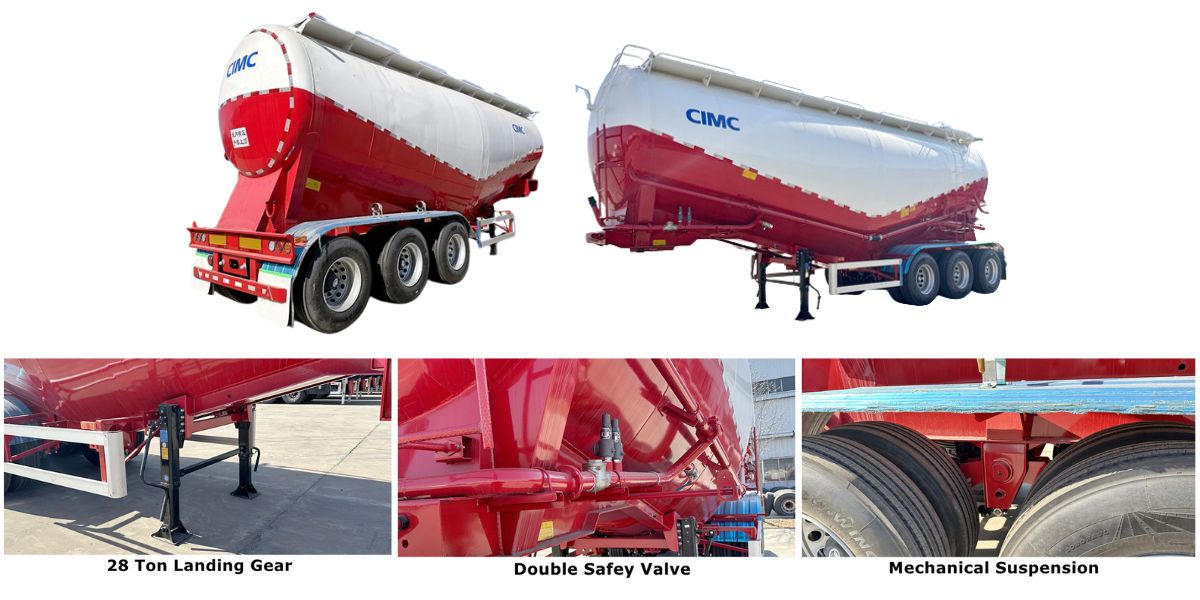
The brand of core components for CIMC cement bulker trailer is also an important factor in determining the price. For example, axles can be from different brands such as FUWA and BPW, suspension can be mechanical or air suspension, and tires come in ordinary brands and international high-end brands. Although high-end configurations are more expensive, they can improve vehicle stability, load-bearing capacity, and service life. Especially in long-distance transportation or under harsh road conditions, high-quality components can significantly reduce later maintenance costs. In addition to the above, the CIMC cement bulker price is also affected by factors such as the air compressor, diesel engine, unloading system, and piping configuration. High-performance unloading systems with fast unloading speeds and low residue rates are typically more expensive, but they help customers improve work efficiency, so many large logistics companies prefer high-configuration models.
The regulatory requirements of different countries and regions also affect the final CIMC cement bulker price. For example, some countries have strict requirements on vehicle gross weight, wheelbase, lighting systems, protective devices, and braking systems, requiring exported vehicles to be customized according to local regulations. In markets like Southeast Asia, the Middle East, Africa, and South America, customer requirements for vehicle configuration vary significantly. Some regions require reinforced chassis, while others prioritize lightweight design. Still others require the addition of ABS systems, explosion-proof valves, or special painting processes. These customization requirements increase production costs, so CIMC cement bulker trailer of the same volume often have different prices when exported to different countries.
In general, the CIMC cement bulker price is determined by the overall vehicle configuration, volume, materials and manufacturing processes, core components, transportation regulations, and market environment. For customers, choosing a CIMC cement bulker trailer should not only focus on the lowest price, but also comprehensively consider vehicle quality, transportation efficiency, subsequent maintenance costs, and long-term operating benefits. A reliable and well-configured cement bulker trailer may have a higher initial purchase cost, but it often generates greater economic value in the long run.