1. What is a low bed trailer truck?
2. What is the use of low bed trailer?
3. What is the difference between a lowbed and a flatbed?
4. How much does a CIMC low bed trailer price
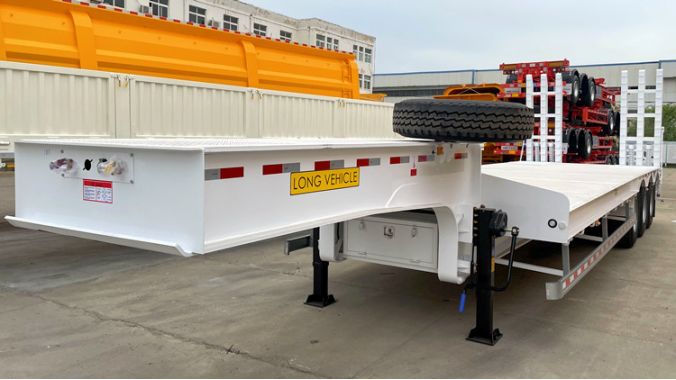
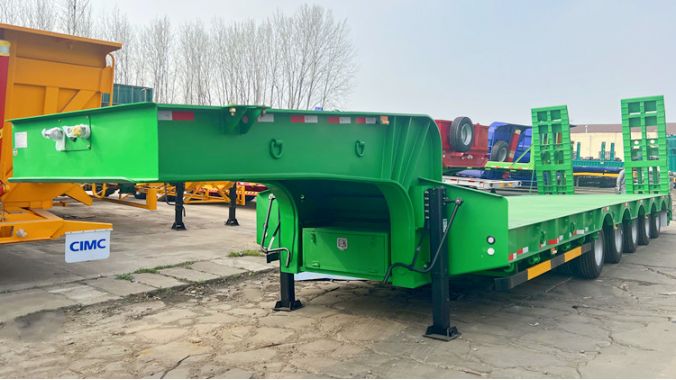
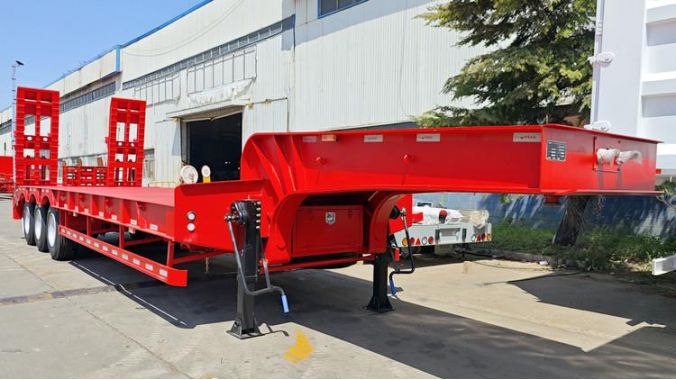
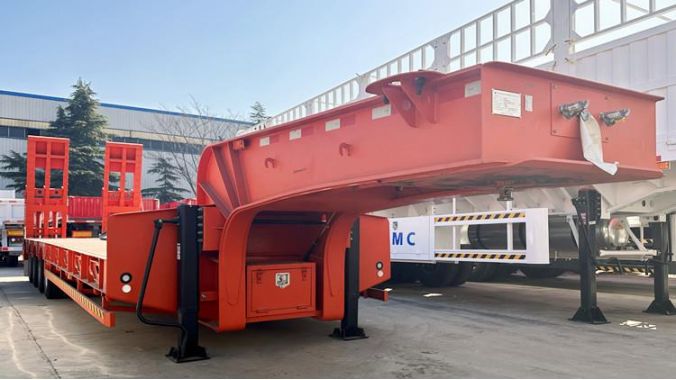
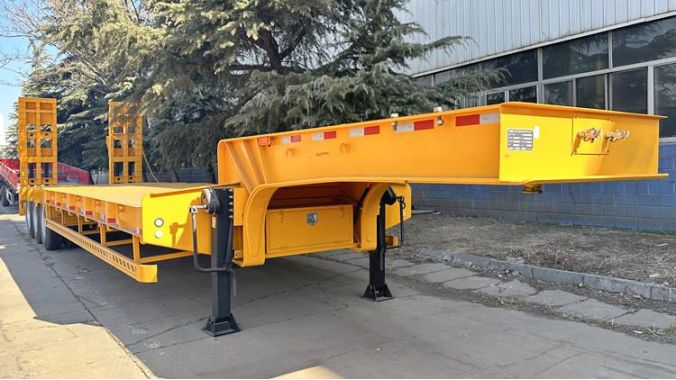
Low bed trailer truck is special trailer designed for transporting oversized and heavy cargo, playing an indispensable role in fields such as construction machinery, port terminals, large equipment manufacturing, and logistics transportation. Unlike flatbed trailers, the core design concept of low bed trailer truck lies in their two characteristics: "low" and "strong." This means that by lowering the height of the platform that carries the cargo, the passability and stability of transporting oversized and overweight cargo are improved, while their robust frame structure enables them to bear weights of tens or even hundreds of tons.
Structurally of the low bed trailer truck typically employs a stepped or concave beam frame structure, generally divided into three distinct parts from front to back: the front is the "gooseneck," shaped like a swan's neck, arching upwards, where the lead pin connects to the saddle on the tractor unit, serving as the power and connection point between the trailer and tractor; the middle is the cargo platform, the lowest part of the frame, which is the load-bearing surface for actual cargo loading; due to its low height, the center of gravity is naturally lowered; and the rear is the wheel frame, integrating the wheels, suspension, and braking system. This unique design of low bed trailer truck allows the cargo platform to be significantly lower than the height of ordinary tires. When transporting large construction machinery (such as excavators, bulldozers, and cranes), wind power equipment, rail vehicles, and other oversized cargo, it significantly lowers the vehicle's center of gravity, providing better stability and safety during high speed driving or turning, and allowing for smooth passage over overhead obstacles such as bridges and tunnels with height restrictions.
In terms of load-bearing capacity, to handle heavy cargo, the longitudinal beams of the frame adopt a high-strength alloy steel box-section and are manufactured using high-strength welding processes such as automatic submerged arc welding to ensure extremely high rigidity and torsional resistance. Depending on the number of axles and tire specifications, the load capacity of low bed trailer truck ranges widely, with light-duty models around 40 tons, while heavy-duty multi-axle (such as 5 axle and 6 axle)low bed trailer truck used for transporting large items can have a load capacity of over 100 tons. The rear of the low bed trailer truck is designed with a detachable or foldable ramp; when loading, the ramp is lowered, allowing construction machinery to drive itself onto the loading platform.
Low bed trailer truck are an irreplaceable mainstay in modern engineering logistics transportation. Through its unique low loading platform design and robust structure, it cleverly solves the problem of transporting oversized, overweight, and overlength large equipment that ordinary trucks cannot handle. Whether in highway construction, mining, or energy facility construction, low bed trailer truck provide crucial technical support for the transfer and delivery of large equipment.
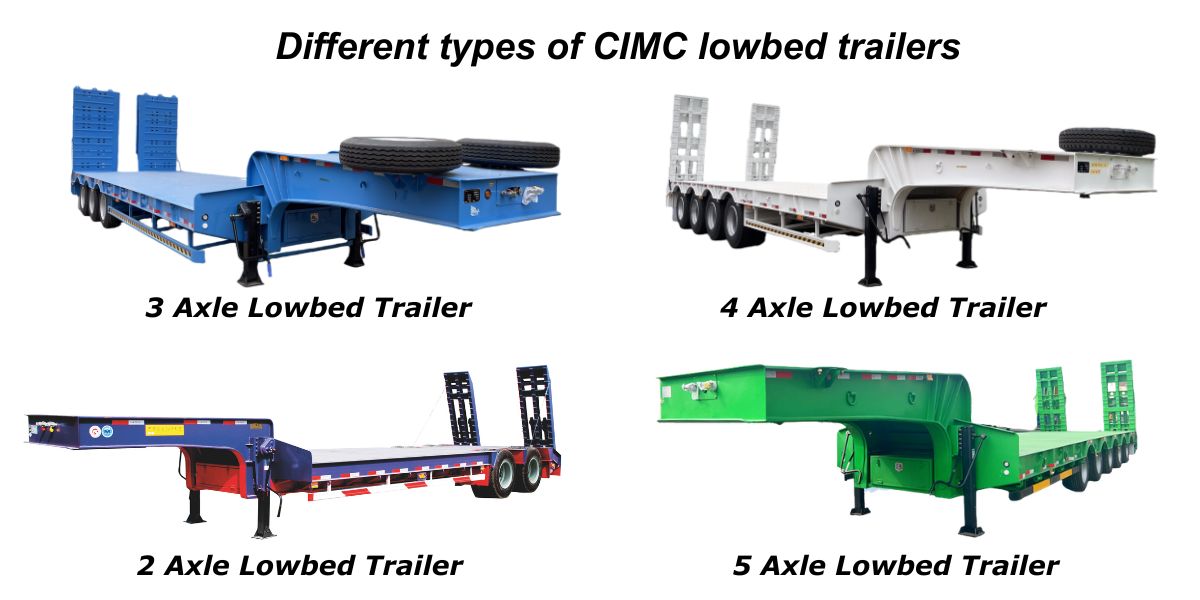
Advantages of CIMC low bed trailer truck
CIMC low bed trailer truck enjoy a high reputation in the global engineering logistics transportation field. Their advantages are not reflected in a single configuration, but rather in a comprehensive system solution encompassing material selection, structural design, manufacturing processes, and after-sales service.
CIMC's design team extensively utilizes internationally advanced finite element analysis (FEA) and Pro-E 3D design software during product development. This means that every stress point of the chassis and the layout of every crossbeam has undergone precise calculation and optimization, rather than relying solely on rough reinforcement based on experience. This scientific analytical method ensures a more uniform stress distribution when the CIMC low bed trailer truck bears enormous pressure, preventing fatigue cracks caused by excessive localized stress. In terms of raw material selection, CIMC insists on using high-strength steel, especially 16Mn grade steel, whose main chassis structure has a strength more than 1.6 times that of ordinary carbon structural steel chassis.
CIMC's production line is highly automated and intelligent. CIMC low bed trailer truck main components are cut using laser cutting, ensuring millimeter-level dimensional accuracy. Key welds are automatically completed by robots, resulting in aesthetically pleasing welds and, more importantly, consistently reliable weld quality, completely eliminating issues like incomplete or missed welds caused by human error.
For surface treatment, CIMC employs passenger car-grade KTL electrophoretic coating technology. The entire low bed trailer truck frame undergoes multiple processes including pretreatment, shot peening, electrophoretic primer application, and topcoat spraying. The advantage of this method is that the paint penetrates every tiny pore on the metal surface of the frame, forming extremely strong adhesion and providing corrosion protection far superior to ordinary paint commonly found in the market. This not only keeps the vehicle's appearance bright for a long time but, more importantly, significantly slows down the rusting rate of the frame in harsh environments such as humidity and salt spray, significantly extending the vehicle's service life and even achieving the Sa2.5 standard for marine corrosion protection.
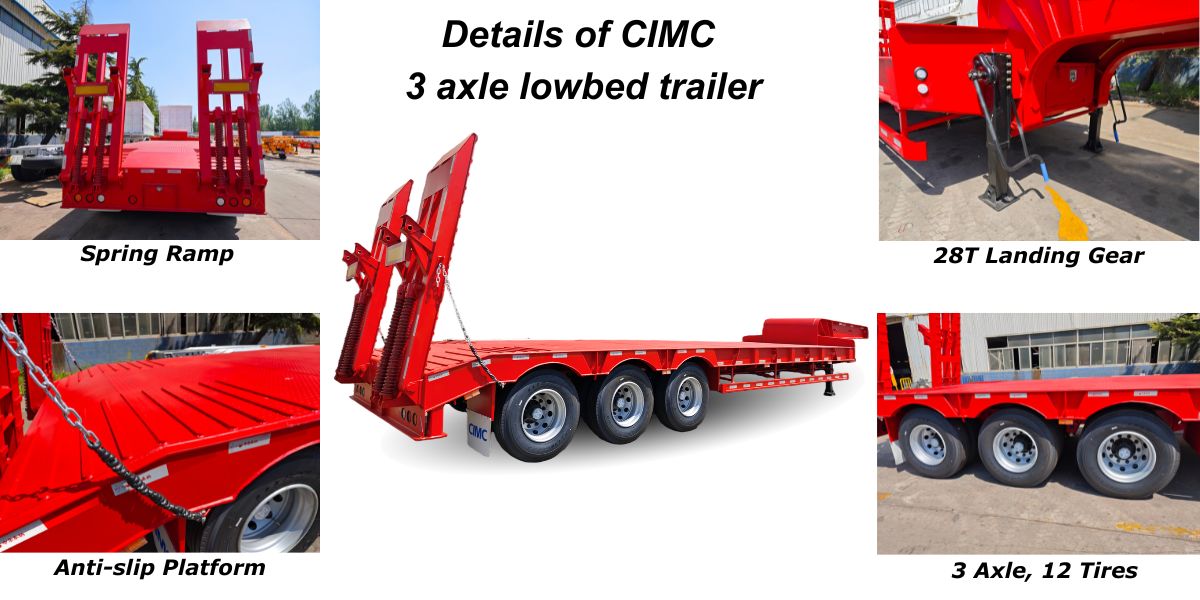
As a specialized transportation tool, the main uses of CIMC low bed trailer truck can be summarized as follows:
Transporting Construction Machinery:
This is one of the core uses of CIMC low bed truck. They are specifically designed for transporting various types of large, non-disassembly-compatible construction machinery, such as excavators, bulldozers, loaders, road rollers, pavers, and truck cranes. These machines are typically very heavy and cannot travel long distances on their own. CIMC low bed truck, with their low loading platform and hydraulic ramp design, allow these machines to be safely and easily loaded onto the low bed trailer, enabling efficient transfers between construction sites.
Transporting Large Industrial Equipment:
CIMC low bed truck is widely used in the energy, chemical, and power construction sectors for transporting various oversized and overweight industrial equipment. Typical cargo includes large transformers, generator stators and rotors, turbine components, heavy pressure vessels, mining machinery, and port machinery. These goods are extremely valuable and require stringent stability during transport. The extremely low center of gravity design of CIMC low bed trailer truck effectively ensures their safety en route, avoiding the risk of rollover or displacement.
Transporting Wind Power and Large Steel Structures:
With the advancement of new energy and large-scale infrastructure construction, CIMC low bed truck has become the mainstay of wind power equipment transportation. They are needed to transport wind turbine blades tens of meters long, massive wind turbine towers, and nacelle assemblies. In addition, they are widely used to transport precast bridge beams, large building steel structural components, and ultra-long pressure pipelines, which are typically characterized by their length, size, and non-disassembly nature.
Transporting Special Vehicles and Military Equipment:
CIMC low bed trailer truck also undertake the transportation of special vehicles and military equipment. For example, they can be used to transport large fire trucks, mobile air compressors, drilling rigs, and various military wheeled or tracked vehicles (such as armored vehicles and tanks). This type of transportation often places special requirements on the vehicle's maneuverability, concealment, and reliability; the robust structure of the CIMC low bed truck can meet these stringent equipment transfer needs.
Important Regulatory Restrictions:
It should be noted that, according to relevant road transport regulations, CIMC low bed trailer truck are special-purpose vehicles, and their legal design purpose is "only for transporting large, non-disassembly-compatible objects." Therefore, it is strictly prohibited to engage in the routine transportation of general bulk cargo (such as sand and gravel, coal), green channel cargo (such as vegetables and fruits), or standard containers; otherwise, it will be considered a violation.
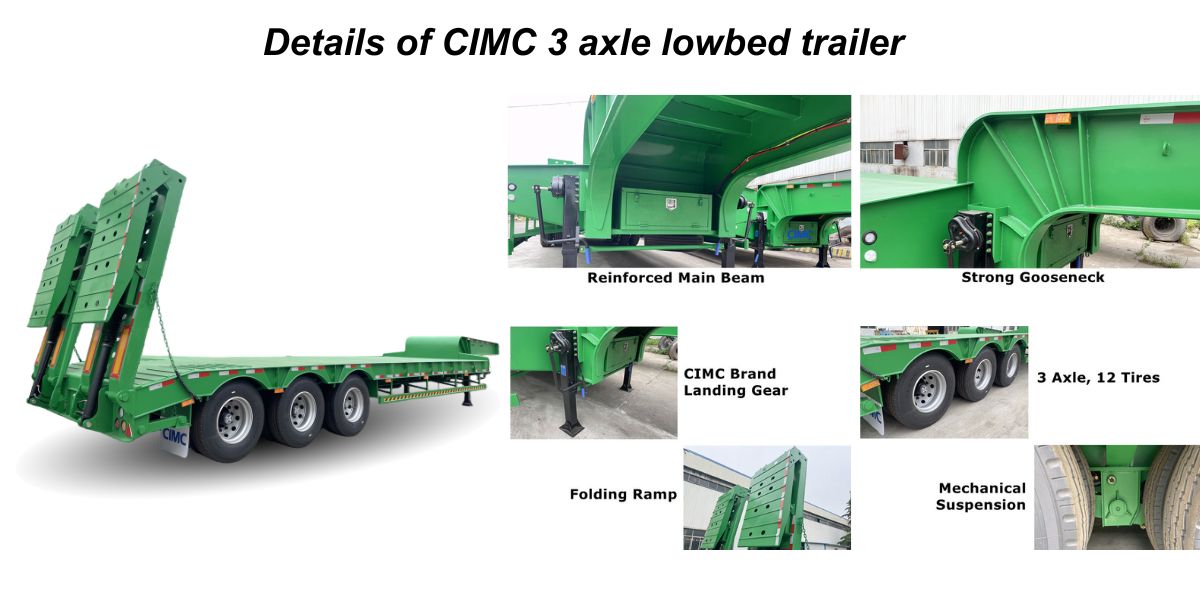
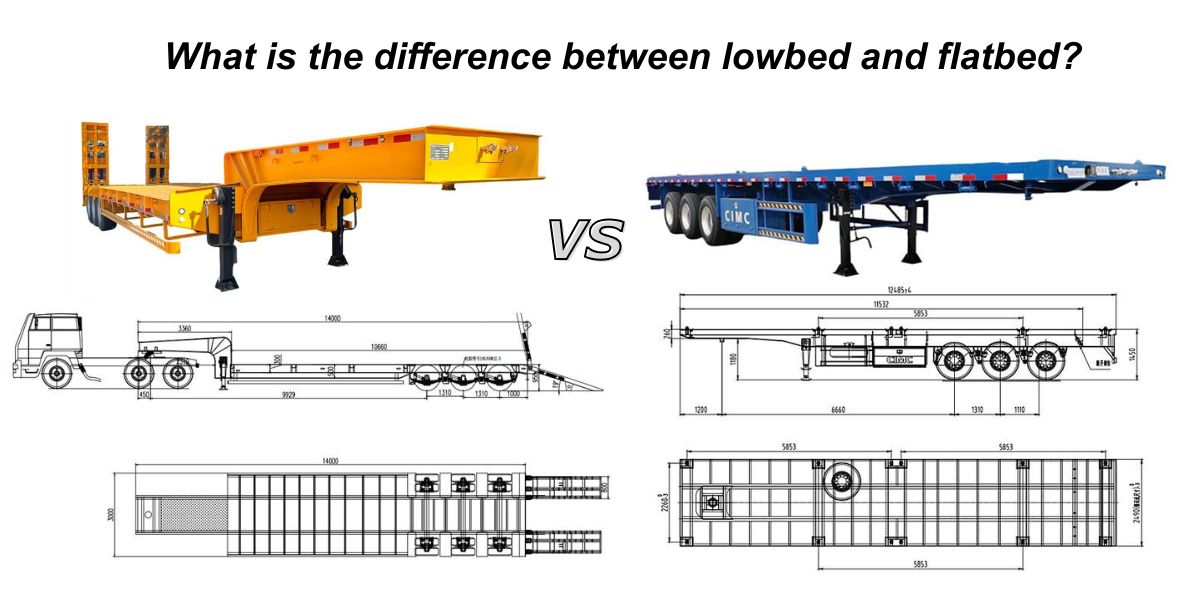
CIMC low bed trailer and flatbed trailer differ significantly in vehicle structure, core purpose, load-bearing characteristics, and regulatory applicability. A detailed comparison is as follows:
1. Different Core Purposes and Applicable Goods:
CIMC low bed trailer is specifically designed for transporting large, non-detachable objects and heavy machinery, such as excavators, bulldozers, loaders, road rollers, and other construction machinery, as well as mining and agricultural machinery. Their design aims to meet the transportation needs of ultra-large and ultra-heavy cargo.
In contrast, the core purpose of flatbed trailer is specifically for loading and transporting international standard containers (such as 20-foot and 40-foot containers), serving multimodal transport systems including shipping, ports, rail, and road, enabling efficient conversion of containers between different modes of transport.
2. Significant Differences in Chassis Structure and Platform Height:
CIMC low bed trailer employ a unique stepped or concave beam chassis structure, with an overall "gooseneck" shape—the front gooseneck arches upwards to connect with the tractor, the middle platform is significantly lowered, and the rear is a wheel frame. This design results in a very low main platform, leading to an extremely low center of gravity and ensuring stability when transporting oversized cargo and the ability to pass overhead obstacles.
The frame structure of a flatbed trailer is relatively simple. Its upper surface remains flat, with the entire surface dedicated to supporting the container. It doesn't pursue an extremely low platform height, but rather needs to match the standard height of the container's bottom structure and transfer equipment.
3. Different Load-Bearing Structures and Loading/Unloading Methods:
To support heavy machinery, CIMC low bed trailer typically use I-beam cross-sections for the longitudinal beams, providing extremely high rigidity and strength. The frame has a through-beam structure, capable of withstanding concentrated loads from wheeled or tracked machinery. For loading and unloading, CIMC low bed trailer is usually equipped with spring, folding or hydraulic ramps, allowing heavy machinery to drive onto the platform from the rear of the vehicle.
The load-bearing structure of the flatbed trailer is designed around the standardized transshipment needs of containers. Fixed or concealable twist-lock devices are installed at the four corners and the middle of the frame. During loading, the container is hoisted onto the frame, and the twist-locks automatically engage with the corner fitting holes at the bottom of the container and lock, achieving quick fixation and release. This standardized design supports rapid loading and unloading and direct transshipment between different transport vehicles without removing the goods from the container.
The CIMC low bed trailer price is influenced by various factors, and there is no fixed, uniform price. According to publicly available market information, the price ranges from approximately 12,000 to 26,000 USD, depending on the vehicle's size, configuration, technical standards, and procurement scale. The following are the main factors determining the CIMC low bed truck price.
The basic dimensions of the vehicle are the primary factor affecting price. The vehicle's size and number of axles directly determine the amount of steel used, structural complexity, and load-bearing capacity, thus having the most direct impact on the CIMC low bed trailer price. Extended low bed trailer designed for heavy haulage are more expensive due to their more complex structure and longer steel frames. Low bed trailer truck is designed for transporting heavy machinery; the strength of the longitudinal beams of the frame, the grade of steel, the suspension system (mechanical springs or more expensive air suspension), and the specifications and number of tires (e.g., 12 tires are common configurations) all determine the weight the vehicle can safely carry, and these high-performance configurations also mean a higher CIMC low bed trailer price.
CIMC low bed trailer truck often need to be customized according to specific uses, and the degree of customization is key to determining the final transaction price. Special requirements from customers regarding the length and width of the cargo platform, whether it is equipped with type of ramp, and the securing points on the vehicle, all increase design and manufacturing costs. Therefore, the final CIMC low bed truck price is usually determined by the user and manufacturer through a contract based on detailed requirements.
Steel is the main raw material for CIMC low bed trailer price, and its market price fluctuations directly affect the vehicle's manufacturing cost and final pricing. Furthermore, the quantity purchased is also an important price lever; the unit price differs between single-unit purchases and bulk purchases (such as buying 5 or 10 units at a time).
The technical standards and manufacturing processes of the product will create CIMC low bed truck price differences. As an industry leader, CIMC Vehicles is committed to shifting the industry from "price wars" to "value wars," with its products focusing more on standardized, modular design and automated production. Vehicles manufactured using more advanced digital design, robotic automated welding, and high-specification anti-corrosion coating processes such as KTL electrophoresis have advantages in durability, reliability, and service life, and their initial purchase cost is naturally higher than products manufactured using traditional processes.
Brand value and after-sales service guarantees are included in the price. In addition to tangible hardware configurations, CIMC's brand value as a well-known listed company, its nationwide team of expert technical services, and its more comprehensive after-sales service system also contribute to the price of its products.